Anime Like Chameko’s Day
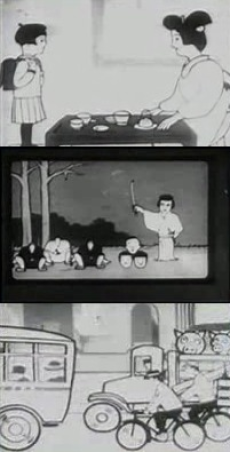
It puts you in a room with a kid in 1931 and dares you to be bored. Nothing happens: Chameko wakes, washes, eats, goes to school, plays, comes home, sleeps. That's the whole movie, marched along by a chirpy children's tune that carries the picture the way a nursery rhyme carries a toddler down a sidewalk. What sneaks up on you is the date. This is pre-war Japan animating an ordinary morning, no war, no message, no idea what's coming, and the innocence of that lands harder than any epic. The linework is simple and the loops are obvious, but somebody sat there and drew a small girl brushing her teeth like it mattered. Ten minutes, nearly a century old, and it still feels like flipping through someone's childhood photo album.
SYNOPSIS
Chameko navigates an ordinary day in early twentieth-century Japan, where the simplest moments become windows into a vanished world. Her morning unfolds with small rituals and domestic pleasures: helping around the house, interacting with family, discovering amusement in everyday objects and situations. What might seem mundane becomes genuinely charming as the film captures how a child finds joy in the accessible world around her. The humor emerges naturally from Chameko's perspective and reactions rather than forced gags. There's a lightness to the storytelling that lets viewers inhabit her headspace, seeing through her eyes as she moves between tasks, play, and observation. The animation carries a nostalgic quality that reflects its historical moment, making the viewing experience feel like peering through a time capsule.