Anime Like Straight into the Universe
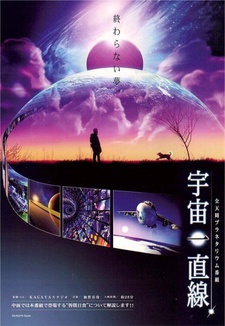
This one doesn't ask for your attention, it just tilts your head back and takes it. KAGAYA built his whole career on painting starfields and zodiac myths in CG, and here the fulldome format turns that into something closer to a ride than a movie: Greek constellation figures unspooling overhead, the astronomy kid's obsession rendered at the scale it always lived at in his head. Then it cuts to real footage of the 2003 total solar eclipse shot in Antarctica, the first time humans ever caught that one, and the switch from gorgeous rendered space to actual sky is the whole point. No trauma arc, no twist, just a guy who loved the stars enough to build a career out of drawing them and telling you to do the same. Slept on because most people never got to see it projected right."Enjoy science and art" lands harder than it should.
SYNOPSIS
A young stargazer grows into an artist obsessed with capturing the cosmos through his brush and lens. His visions blend scientific observation with mythological wonder, weaving together constellations, Greek legends, and the raw majesty of the night sky into sweeping visual compositions. Using cutting-edge fulldome projection technology, his work transforms flat screens into immersive windows onto infinite space. Viewers find themselves suspended among stars, galaxies, and ancient myths come alive across 360-degree canvases. The film pairs these fantastical digital paintings with breathtaking real-world footage of a total solar eclipse captured during a historic 2003 expedition to Antarctica, the first time humanity witnessed totality from that frozen continent. The experience asks a fundamental question: what draws us to look upward? Between scientific precision and artistic imagination, between what we can measure and what we can dream, lies a space where wonder lives. This is cinema as portal, inviting audiences to understand why some people dedicate their lives to the pursuit of infinity.