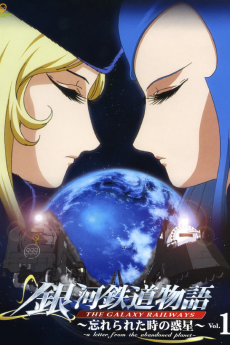
Anime Like The Galaxy Railways: A Letter from the Abandoned Planet
It puts two Leiji Matsumoto rail lines on the same track and dares you not to get chills. The Galaxy Express 999 goes down on a dead world, and suddenly Maetel and Tetsuro, the ten-year-old street kid with more heart than the adults around him, are cargo waiting on a rescue that may not come. The SDF's Sirius Platoon draws the job, and this is a franchise that has never pretended a uniform makes you survivable. The Herise Time Mystery is the real antagonist, a rift in the deep axis of time and space that does not care who it swallows, and the threat is that it repeats. Four episodes, no filler, all of it about people throwing themselves at a clock that already won once. If the Conductor's silhouette and a train whistle in vacuum do something to your chest, you already know why you're here.
SYNOPSIS
A luxury space train crashes on an isolated world, stranding its passengers in a race against catastrophe. The Conductor, Maetel, and young Tetsuro find themselves trapped on a planet caught in a temporal loop, where reality itself fractures and reforms endlessly. A rift in spacetime called the Herise Time Mystery devours everything in its path, and the countdown to destruction continues relentlessly. The SDF Sirius Platoon springs into action, navigating treacherous terrain and the planet's unstable environment to reach the crash site. What begins as a straightforward rescue mission becomes a desperate struggle against forces beyond conventional understanding. Time works differently here. The laws of physics bend and twist. Every decision carries weight when seconds might stretch into hours or vanish entirely. Tetsuro's innocence contrasts sharply with the grim reality around him, grounding the story in human emotion even as cosmic horror unfolds. The crew must solve the mystery of the planet itself to escape, piecing together fragments of history and time while the rift consumes everything closer.